
The Morning Routine That Supports Higher Testosterone All Day
The Morning Routine That Supports Higher Testosterone All Day
TL;DR: Testosterone peaks in the morning and tapers through the day. What you do in the first 60 minutes either protects that peak or disrupts it. Checking your phone first thing spikes cortisol. Skipping sunlight blocks vitamin D synthesis and delays your circadian reset. Drinking the right coffee instead of the wrong kind is the smallest habit swap with the most compound benefit.
Testosterone follows a circadian rhythm. For most men, levels peak between 6 and 10 AM and decline through the day. That morning surge is what drives clarity, motivation, and the physical readiness to do something demanding.
The problem is that modern mornings are designed, largely by accident, to kill it.
Here's a practical routine based on what the physiology actually supports - not wellness content, just the mechanisms.
Step 1: Don't touch your phone for 30 minutes

This is the one most men resist because it feels unrelated to testosterone. It's not.
Checking your phone - news, email, social media - triggers an immediate cortisol response. Your brain reads incoming information as potential threats that need processing. The cortisol awakening response, which is natural and helpful for waking up, gets extended and intensified by this kind of stimulus.
Cortisol and testosterone have an inverse relationship. Prolonged cortisol elevation in the first hour suppresses the morning T peak before you've left the house. The highest-testosterone start to your day is a quiet one.
Thirty minutes offline. Hydrate, stretch, let the morning T peak run its full course before you start loading the nervous system with demands.
Step 2: Get outside and get sunlight
Morning light exposure serves two purposes.
First: it resets your circadian rhythm. Natural light signals the SCN - the brain's master clock - that the day has started. This regulates the hormonal cascade that follows, including LH and FSH, which are the upstream signals for testosterone production.
Second: UVB light triggers vitamin D synthesis in the skin. Pilz et al. (2011) showed that men who supplemented enough vitamin D to move from deficient to sufficient increased total testosterone by 25.2% over one year. But for men north of about 45° latitude - which includes most of northern and central Europe - the sun from October through March is too low in the sky to trigger vitamin D synthesis even on clear days. Supplementation is necessary in winter; sunlight still resets the circadian rhythm year-round and that alone is worth five minutes outside.
Five to ten minutes. Doesn't have to be warm. Just outside.
Step 3: Coffee that actually does something
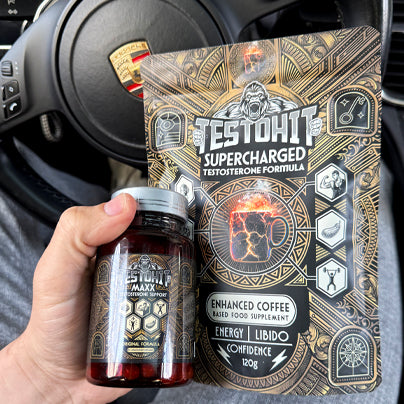
Most morning coffee is a tool for surviving poor sleep. The caffeine compensates for the rest deficit and gets you functional.
SUPERCHARGED reframes this. Instead of using your morning coffee as damage control, SUPERCHARGED is formulated as a positive hormonal input.
Shilajit supports mitochondrial efficiency in the Leydig cells where testosterone is produced. Fenugreek reduces the conversion of testosterone into estrogen, keeping more of what your body produces in its bioavailable form. Zinc - which most active men are chronically short on - is required for LH receptor signaling. Without it, the production signal from your brain doesn't fully reach the testes.
The creatine is separate in purpose but practical: it gives you something immediate. Your morning feels different within the first week, which matters for sustaining the habit long enough for the hormonal stack to build its effects.
Step 4: Some kind of movement
Full gym session or 15 minutes at home - the dose matters less than the fact of doing it.
Even moderate exercise in the morning - a fast walk, some compound bodyweight movements - improves testosterone for several hours and improves insulin sensitivity, which is directly tied to hormonal health. Resistance training generates the largest T response, but the bar doesn't need to be that high every day.
If you have time for a full session: compound lifts, progressive overload, under 60 minutes. If you don't: 20 minutes of something vigorous still counts.
Step 5: Protein at breakfast, or none at all
A high-carbohydrate breakfast - cereal, toast, pastry - causes a fast insulin spike that can temporarily suppress testosterone. The body shifts into a storage and processing state rather than a performance state.
Two better options: a protein-heavy first meal (30-40g; eggs, Greek yogurt, a quality protein source), or skip breakfast entirely if you practice intermittent fasting. Both are fine hormonally. The goal is avoiding a large, fast glucose load as your first input of the day.
If you fast, SUPERCHARGED is coffee - it fits a fasting window.
Step 6: Cold water at the end of your shower
The evidence on cold showers and testosterone directly is thin. This one earns its place for a different reason.
Cold exposure increases norepinephrine, activates brown fat, and builds stress resilience. The indirect benefits for hormonal health - better metabolic function, lower resting stress response - are real. More practically: ending a shower with 60 seconds of cold water is a daily practice of choosing discomfort. That kind of mental discipline tends to correlate with the other habits that support high T.
How long before this shows
Most men notice a difference in morning energy and mental clarity within 7-10 days. By the end of the first month, gym performance and recovery typically improve. The hormonal changes - the ones that show on blood work and in how your body composition responds to training - develop over 60-90 days of consistency.
The morning routine doesn't produce a single dramatic change. It removes a series of daily disruptions to your hormonal baseline and replaces them with inputs that support it. Over time that compounds.
Frequently Asked Questions
Can I drink boost on an empty stomach?
Yes. Many people use it as part of an intermittent fasting protocol with no issues.
What if it's dark when I wake up in winter?
A high-intensity SAD lamp (10,000 lux) placed within a meter of you for 20-30 minutes mimics the circadian reset that sunlight provides. It won't trigger vitamin D synthesis, but it resets the clock and regulates the hormonal cascade that follows.
Is breakfast mandatory for high testosterone?
No. Intermittent fasting can support T levels by improving insulin sensitivity. What matters is that when you do eat, the meal is protein-dense and not dominated by fast carbohydrates.
Will this routine help with muscle growth?
Yes, indirectly. By optimizing your hormonal baseline, you make the training stimulus more effective. The same workout produces better results when the hormonal environment supports it.
Does the order of these steps matter?
The most important sequencing: phone offline and sunlight exposure are time-sensitive (first 30-60 minutes). Coffee, movement, and breakfast can flex. Consistency across all of them matters more than getting the order exactly right every day.


