
How to Boost Testosterone Naturally (Without Injections or Prescriptions)
How to Boost Testosterone Naturally (Without Injections or Prescriptions)
TL;DR: Your body wants to produce testosterone. It just needs the right conditions and the right raw materials. One week of five-hour sleep drops T-levels by 10-15%. Getting below 18% body fat removes a major source of T-to-estrogen conversion. Zinc, vitamin D, and shilajit have real clinical backing. This is what actually works - no magic bullets.
The supplement industry makes natural testosterone optimization sound complicated. Exotic stacks, proprietary blends, trademarked compounds. Usually as a setup to sell you something expensive.
The reality is more straightforward. The biggest levers are behavioral, not biochemical. And the supplements that matter are a short list of well-studied compounds - not a cabinet full of mystery herbs.
Here's what the evidence actually supports.
Sleep is the lever most men underestimate
If a drug could increase testosterone by 10-15% in a week with no side effects, it would be a billion-euro product. The intervention that actually does that is sleep.
Leproult and Van Cauter published a study in JAMA in 2011: 10 healthy young men, one week of sleep restricted to five hours per night. Daytime testosterone levels dropped 10-15%. The participants also reported worsened mood and wellbeing as the week progressed - consistent with the hormone changes.
The mechanism isn't complicated. Most testosterone is produced during sleep, particularly during the first REM cycle. Cut the sleep, cut the production window.
Quantity matters: 7.5-8 hours for most men. Quality matters too - alcohol disrupts REM sleep, so even if you're in bed for eight hours, two drinks before bed means you're getting far less of the deep sleep where testosterone production peaks. Consistency matters: the same wake time every day trains your circadian rhythm and stabilizes the hormonal patterns that depend on it.
If you're doing one thing after reading this, it's fixing sleep before anything else.
Resistance training - but the right kind
Not all exercise is equally useful here. Long-distance cardio done to excess can actually suppress testosterone if it's chronic and recovery is inadequate.
What triggers a meaningful hormonal response is moving heavy weight through compound movements. Squats, deadlifts, bench press, barbell rows, overhead press. These recruit the most muscle mass and generate the largest acute hormonal response.
Progressive overload is essential. Your body produces testosterone partly as a response to the demand for strength. If the training load never increases, the hormonal stimulus plateaus. Give your body a consistent reason to maintain and build muscle, and the endocrine system supports it.
Three to four sessions per week. Sessions under 60 minutes keep cortisol from spiking hard enough to counteract the T-boost. More isn't better past that point.
Body fat and the aromatase effect
Fat tissue contains aromatase - an enzyme that converts testosterone into estrogen. The more body fat, particularly visceral fat around the midsection, the more conversion is happening. Lower testosterone makes fat loss harder. More fat means more conversion of remaining testosterone. The cycle self-reinforces.
Getting body fat below 15-18% is one of the most effective testosterone interventions available, and one of the least talked about. It doesn't require extreme dieting - just sustained, moderate caloric deficit combined with the resistance training above. Both improve body composition and both have independent hormonal benefits.
The micronutrients that actually matter
Zinc and vitamin D are where most of the solid evidence lives for natural supplementation.
Zinc is a cofactor for luteinizing hormone signaling (the signal that tells your testes to produce testosterone) and inhibits aromatase. Prasad et al. (1996) showed that restricting zinc in healthy young men dropped their testosterone by 75% over 20 weeks. When zinc-deficient older men were supplemented, their levels nearly doubled. It's not a booster - it's a foundation. Without adequate zinc, the machinery stalls.
Vitamin D behaves more like a hormone than a vitamin. Receptors for it are found directly on the Leydig cells in the testes where testosterone is synthesized. Pilz et al. (2011) showed that supplementing vitamin D3 at 3,332 IU daily for one year increased total testosterone by 25.2% in men who started deficient. Over 40% of European men are deficient, particularly in winter.
Beyond those two: healthy dietary fats matter because testosterone is synthesized from cholesterol. An ultra-low-fat diet starves hormone production. And cortisol management - reducing chronic stress - is directly tied to testosterone levels, since cortisol and testosterone have an inverse relationship.
Where supplementation fits in the picture
Natural compounds work within your biology. They don't override bad habits.
If sleep is broken, training is nonexistent, and body fat is high, no supplement closes that gap. But for men who've addressed the foundations and want to fill specific nutrient gaps or support the hormonal system more directly, there's clinical backing for several ingredients.
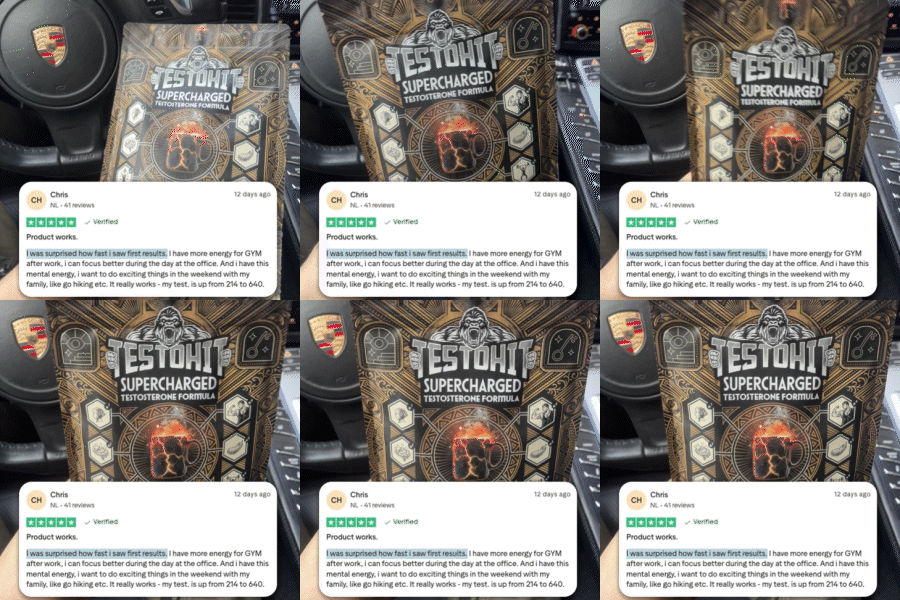
Shilajit - a mineral resin from Himalayan rock formations - showed a 20.45% increase in total testosterone in healthy men over 90 days in a properly designed clinical trial (Biswas et al., Andrologia, 2016). These weren't deficient men. That's optimization, not correction.
Fenugreek helps preserve free testosterone by blocking the enzymes that convert it into estrogen. Two clinical trials support this at doses of 500-600mg/day.
SUPERCHARGED combines these with zinc, vitamin D, magnesium, maca, creatine, and B vitamins in a morning coffee format. The format isn't incidental - these ingredients need to be taken daily for months to build cumulative effect. Coffee is the one habit most men don't skip.
What's not worth the money
Proprietary blends where you can't see the individual dosages. Anything promising "steroid-like results in 30 days." Products dominated by D-Aspartic Acid, which has inconsistent results in men with normal baseline testosterone. Most testosterone boosters on the market are underdosed vitamins with impressive packaging.
The short list of what works is not exciting. Sleep, resistance training, body composition, zinc, vitamin D, and a few specific plant compounds. That's most of it.
Frequently Asked Questions
How long before results show?
Sleep improvements can affect testosterone within days. Training and body composition changes take 8-16 weeks. Supplementation with shilajit and zinc typically shows measurable improvement at the 6-12 week mark. Plan for 90 days before evaluating.
Can I drink regular coffee while optimizing T?
Yes. Regular coffee has some benefits - caffeine improves performance and there's evidence for antioxidant effects. But it doesn't address the nutritional gaps that SUPERCHARGED covers. It's an opportunity most men miss.
Is lifting every day better for testosterone?
No. Overtraining drives cortisol up, which suppresses T. Rest days are when testosterone builds muscle from the training stimulus. Three to four sessions per week with adequate recovery outperforms daily training.
Does alcohol lower testosterone?
Yes. Acute consumption disrupts the hormonal signaling between brain and testes. Chronic heavy drinking increases conversion of T to estrogen. Even moderate drinking before bed degrades REM sleep quality and therefore the overnight testosterone production window.
Are natural boosters safe?
The well-studied ones at appropriate doses, yes. Zinc, vitamin D, shilajit, fenugreek, and magnesium have strong safety records in healthy adults. The risk profile is far below pharmaceutical interventions and well below TRT.


