
Why Building Muscle Gets Harder After 30
Written by Gatis Strods, founder of TestoHit
TL;DR: Building muscle after 30 is harder due to a combination of declining testosterone (about 1% per year), the onset of anabolic resistance, and slower systemic recovery. To overcome this, men must focus on optimizing their hormonal environment and using evidence-backed supplements like creatine to maintain muscle protein synthesis.
Why Building Muscle Gets Harder After 30 (The Real Reasons)
You hit 30, and suddenly the rules of the gym change. At 22, you could sleep four hours, eat a pizza, and still hit a personal record on the bench press. At 32, you look at a heavy dumbbell and your shoulder starts making sounds like a bag of gravel.
It is not just in your head. Building muscle after 30 is objectively harder. Your body is no longer in "growth mode" by default. It is transitioning into "maintenance mode," and if you are not careful, it quickly slips into "slow decline mode."
But here is the good news: you can still build a physique you are proud of after 30. You just need to understand that the game has changed. You are no longer working with the infinite hormonal resources of a teenager. You are working with a more finite budget. You have to spend it wisely.
Why is it harder to gain muscle after 30?
Gaining muscle after 30 is harder because your baseline testosterone and growth hormone levels begin a steady decline, while your body simultaneously becomes less efficient at using protein for muscle repair (anabolic resistance). This means you have to work harder, eat cleaner, and recover smarter just to see the same results you used to get by "winging it."
The primary driver is the decline in anabolic hormones. After age 30, the average man's testosterone drops by about 1% every single year. By the time you are 40, that is a 10% reduction in the very hormone that tells your body to build and keep muscle. It is like trying to build a house when the supplier keeps sending 1% fewer bricks every week. Eventually, the construction slows down.
What is anabolic resistance?
Anabolic resistance is a physiological state where your muscle cells become less responsive to the signals that trigger growth, such as resistance training and protein intake. Wall et al. (2015) found that older muscles require a higher "dose" of leucine and total protein to stimulate the same amount of muscle protein synthesis as younger muscles.
In your twenties, a small protein shake was enough to flip the "growth switch" (mTOR) to the "on" position. After 30, that switch gets a bit sticky. You need more high-quality protein and more consistent tension on the muscle to get the same response. This is why many men find that their old workout routines suddenly stop working. They are not stimulating the muscle enough to overcome the body's increasing reluctance to grow.
The role of testosterone and growth hormone decline

The decline of testosterone and growth hormone after 30 reduces your body's ability to maintain a positive nitrogen balance, which is essential for muscle growth. Lower T levels also increase the activity of myostatin, a protein that acts as a "brake" on muscle development, making every pound of muscle harder to earn.
When I hit 30, I felt this transition firsthand. I was tired, my recovery was sluggish, and my strength plateaued. It was the hormonal "tax" being collected. Growth hormone, which peaks during deep sleep, also begins to taper off. This is why sleep becomes your most important anabolic tool. If you are not hitting those deep sleep cycles, you are missing out on the primary window for tissue repair and fat oxidation.
Slower recovery and the "injury trap"
Recovery takes longer after 30 because your systemic inflammatory response is slower to resolve, and your connective tissues (tendons and ligaments) lose some of their elasticity. This creates an "injury trap" where men try to train with their old intensity but find themselves sidelined for weeks with nagging joint pain.
Your muscles might be ready for another session, but your nervous system and your tendons often are not. This is where magnesium and zinc come into play. Zinc is a critical cofactor for over 300 enzymes, many of which are involved in protein synthesis and cell division. Magnesium is essential for muscle relaxation and reducing the chronic inflammation that can lead to overuse injuries.
Why sleep quality is your secret muscle builder
Sleep quality directly impacts muscle protein synthesis because the majority of your body's daily growth hormone is released during the first few hours of deep sleep. If your sleep is fragmented or too short, you are physically unable to repair the muscle damage you caused in the gym, leading to a state of chronic overtraining.
Men after 30 often struggle with sleep quality due to stress, blue light exposure, and declining melatonin. This creates a vicious cycle: poor sleep lowers testosterone, and low testosterone makes it harder to get high-quality sleep. Breaking this cycle is the first step to making gains again. Without 7-9 hours of rest, you are essentially spinning your wheels in the gym.
How creatine helps overcome age-related decline
Creatine helps overcome the challenges of building muscle after 30 by providing a ready source of phosphocreatine for ATP production, which compensates for the natural decline in high-intensity energy capacity. Rawson & Volek (2003) demonstrated that creatine supplementation combined with resistance training significantly increases lean body mass and strength across all age groups.
Creatine is the most researched supplement on the planet for a reason. It works. For men over 30, it is particularly useful because it helps maintain the "snap" in your lifts that usually starts to fade with age. It also draws water into the muscle cells, which can help overcome some aspects of anabolic resistance by improving the cell's "swelling" signal for growth. It is not a magic bullet, but at 3g a day, it is the closest thing we have to a physiological "unfair advantage."
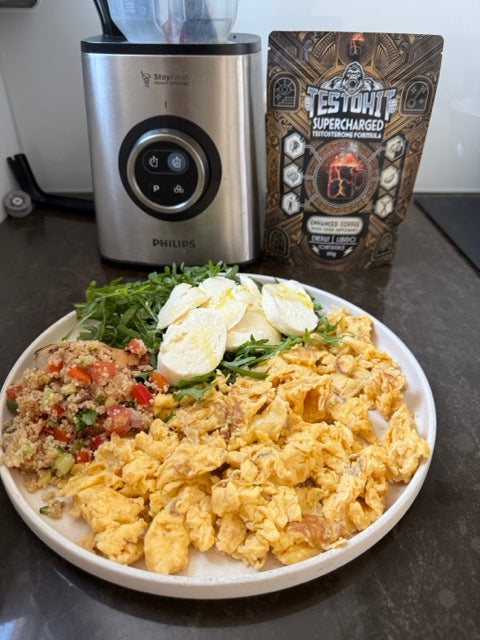
For men dealing with this, SUPERCHARGED covers 3g of creatine daily, along with zinc and magnesium to support recovery and B vitamins for protein metabolism. MAXX adds ingredients like boron and muira puama to further support the hormonal environment needed for growth.
Frequently Asked Questions
Why is it harder to gain muscle after 30?
It is harder to gain muscle after 30 because testosterone and growth hormone levels naturally decline, and muscle cells become less sensitive to protein (anabolic resistance).
Can men over 30 still build muscle?
Yes, men over 30 can absolutely build muscle, but they must prioritize recovery, optimize their protein intake, and manage their hormones more carefully than they did in their twenties.
Does testosterone affect muscle growth?
Testosterone is the primary anabolic hormone in men; it signals muscle cells to increase protein synthesis and prevents the breakdown of existing muscle tissue.
Does creatine help muscle growth after 30?
Creatine is highly effective for men over 30, as it improves energy production during heavy lifts and has been shown by Rawson & Volek (2003) to increase lean mass and strength.
How much protein do men over 30 need?
Men over 30 generally need about 1.6 to 2.2 grams of protein per kilogram of body weight to overcome anabolic resistance and maximize muscle protein synthesis.
How long does muscle recovery take after 30?
Recovery after 30 typically takes 48 to 72 hours for a major muscle group, which is slightly longer than in your twenties due to slower systemic repair processes.


