
Why Men Develop Belly Fat After 30
Written by Gatis Strods, founder of TestoHit
TL;DR: Men develop belly fat after 30 primarily due to declining testosterone levels, which reduces muscle mass and lowers metabolic rate, combined with a rise in cortisol that drives fat storage in the abdomen. This process creates a cycle where belly fat further lowers testosterone by converting it into estrogen.
Why do men get belly fat after 30
The belly doesn't just appear. It's the result of a very logical hormonal chain reaction that your body runs whether you like it or not. You wake up one day, look in the mirror, and realize that your "dad bod" isn't a temporary phase, it’s an architectural change. If you're asking why do men get belly fat after 30, the answer isn't just "too many pizzas." It's a shift in your internal chemistry.
Gatis Strods noticed this shift himself. He was active, he was eating reasonably well, but the midsection was expanding while the chest and shoulders were thinning out. He realized that the battle against the belly isn't won by calories alone; it’s won by managing the hormones that decide where those calories are stored.
The Testosterone-Muscle-Metabolism Link
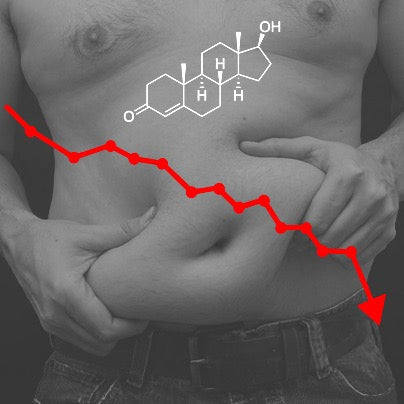
When testosterone levels begin their 1-2% annual decline after age 30, your body loses its primary signal for maintaining muscle tissue. Muscle is metabolically expensive; it burns calories even when you're sitting on the couch. As your T levels drop, you lose muscle mass, which lowers your Basal Metabolic Rate (BMR).
Mårin et al. (Obesity Research, 1993) found that testosterone treatment in men significantly reduced visceral fat, highlighting the direct link between the hormone and fat distribution. Without optimal T, your body becomes more efficient at storing fat and less efficient at burning it. You aren't just eating more; you're burning less.
The Aromatase Vicious Cycle
Belly fat is more than an inert storage depot; it is an active endocrine organ that produces an enzyme called aromatase. Aromatase has one job: it takes your testosterone and converts it into estrogen. This creates a devastating feedback loop for men over 30.
Giagulli et al. (JCEM, 1994) demonstrated how obesity suppresses testosterone. More belly fat leads to more aromatase, which leads to lower testosterone, which leads to even more belly fat. This is why "working off the belly" becomes exponentially harder as you get older. You're fighting your own enzymes.
Cortisol: The Belly Fat Driver

High levels of cortisol, the stress hormone, are directly linked to the accumulation of visceral fat, the dangerous fat deep inside your abdomen. Bjorntorp (1993) identified the cortisol-visceral fat connection, explaining how stress literally tells your body to pack on weight around your organs.
In your 30s, life stress usually peaks. Career pressure, family responsibilities, and lack of sleep keep your cortisol levels chronically high. This high cortisol not only stores belly fat but also inhibits testosterone production, doubling down on the hormonal imbalance that keeps you soft in the middle.
Fenugreek and Aromatase Inhibition
Fenugreek is a powerful natural tool for men looking to break the aromatase cycle and support their testosterone levels. It contains compounds that have been shown to act as mild aromatase inhibitors, preventing the conversion of T into estrogen.
By reducing the conversion rate, you keep more of your natural testosterone available for muscle maintenance and fat metabolism. Wankhede et al. (Journal of the International Society of Sports Nutrition, 2010) found that fenugreek supplementation significantly improved body composition and strength in men. It’s a key reason why it’s included in the boost formula.
Zinc, Magnesium, and Metabolic Health
Zinc and magnesium are essential for the enzymes that manage your metabolism and keep your hormones in check. Zinc deficiency is specifically linked to low testosterone and increased body fat. If you’re low on zinc, your body can’t produce the T needed to keep your metabolism fired up.
Magnesium helps regulate insulin sensitivity. When your insulin is stable, your body is less likely to store excess glucose as belly fat. Most men are deficient in both, making the "belly fat after 30" issue even harder to solve without targeted supplementation.
Frequently Asked Questions
Why do men get belly fat after 30?
The primary reason is a decline in testosterone which leads to muscle loss and a slower metabolism, combined with high cortisol levels that drive fat storage in the abdomen. On top of that, an enzyme in fat tissue called aromatase converts testosterone into estrogen, further worsening the problem.
Does low testosterone cause belly fat?
Yes, low testosterone is a major driver of visceral fat accumulation. Testosterone is responsible for maintaining muscle mass and regulating fat distribution; when it drops, the body naturally begins to store more energy in the abdominal area.
Does belly fat lower testosterone?
Belly fat actually acts as a hormone-producing tissue that converts testosterone into estrogen via the aromatase enzyme. This means the more belly fat you have, the faster your body destroys its own testosterone supply, creating a difficult-to-break cycle.
How do I lose belly fat caused by low testosterone?
Losing hormone-driven belly fat requires a combination of resistance training to rebuild muscle, stress management to lower cortisol, and nutritional support to boost testosterone. Supplements containing zinc, magnesium, shilajit, and fenugreek can help restore the hormonal balance needed for fat loss.
Does creatine help with belly fat?
Creatine helps by supporting muscle mass preservation and improving workout intensity. While it doesn't "burn" fat directly, more muscle tissue leads to a higher resting metabolic rate, which makes it easier to maintain a lean midsection over time.
Does cortisol cause belly fat in men?
Cortisol is known as the "belly fat hormone" because it triggers the storage of visceral fat around the internal organs. High stress, lack of sleep, and chronic overworking keep cortisol high, making it nearly impossible to lose belly fat regardless of diet.
If you want to address this properly, SUPERCHARGED covers the key bases - zinc, shilajit, magnesium, creatine, fenugreek - in your morning coffee. MAXX adds DAA, Rhodiola, and Boron for the full stack.


