
How Much Creatine Per Day? The Correct Dose (and Why Most People Get This Wrong)
Written by Gatis Strods, founder of TestoHit
TL;DR: For most people, taking 3-5 grams of creatine monohydrate per day is the optimal dose. You do not need a loading phase, although it can help you see results faster. Timing is less important than consistency, and there is no need to cycle off the supplement.
The Standard Dose: 3 to 5 Grams Per Day
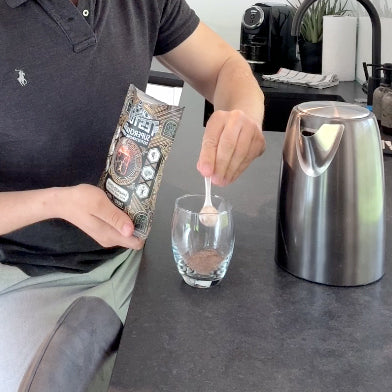
If you want the short answer, here it is: 3 to 5 grams of creatine monohydrate every day is enough for the vast majority of people.
Creatine is one of the most studied supplements in the world. Thousands of trials have looked at how much you need to saturate your muscles. The consensus is that once your muscles are full, you only need a small daily amount to replace what your body uses and excretes. For a typical adult male, that amount is roughly 3 to 5 grams.
Many people get this wrong by thinking that more is always better. They take 10 or 20 grams a day indefinitely, thinking it will lead to faster muscle growth. This is a misunderstanding of how creatine works. Your muscles have a storage limit. Once they are saturated, any extra creatine you take is simply filtered by your kidneys and passed through your urine. Taking double the dose doesn't give you double the gains. It just wastes your money.
The Biochemistry of Saturation
Your body naturally stores around 120 to 140 grams of creatine. Most of this is in your muscles. Each day, your body breaks down about 1% to 2% of its creatine stores into creatinine, which is then excreted. This means you need to replace about 2 to 3 grams a day through diet or supplementation.
If you eat a lot of red meat or fish, you might get 1 to 2 grams of creatine from your food. But to reach full saturation (around 160 grams for an average adult male), you need that extra daily push. The 3 to 5 gram dose provides that surplus. Once you reach 160 grams, you are essentially "full." Any additional creatine you take will not be stored in your muscles. It stays in your blood until your kidneys filter it out.
The Loading Phase: Is It Necessary?
One of the most common questions is whether you should "load" creatine when you first start. A loading phase involves taking a high dose (usually 20 grams per day, split into four doses) for 5 to 7 days. After that, you drop down to the maintenance dose of 3 to 5 grams.
The purpose of loading is to saturate your muscle stores as quickly as possible. When you take 20 grams a day, your muscles reach full capacity in about a week. You will likely see an immediate increase in body weight (from water being pulled into the muscle) and a noticeable improvement in strength and gym performance.
What the Research Says About Loading
A landmark study by Hultman et al. (Journal of Applied Physiology, 1996) compared different dosing strategies. They found that both a high-dose loading phase and a consistent low-dose strategy (3 grams per day) eventually lead to the same level of muscle saturation.
The difference is how long it takes to get there. The loading group reached saturation in 6 days. The 3-gram group took 28 days to reach the same endpoint. So, loading is not necessary, but it is faster. If you want to feel the effects by next week, load. If you aren't in a rush and want to avoid the potential stomach upset that can come with 20 grams of powder, just take 3-5 grams from day one. In a month, you will be in the exact same place.
Dose and Body Weight: Does Size Matter?
While 3 to 5 grams is the standard recommendation, your body size can play a role. A 60kg marathon runner has less muscle mass to saturate than a 110kg bodybuilder.
If you are a larger man with significant muscle mass, you might find that 5 grams is a better maintenance dose for you. Some researchers suggest a dose of 0.05 grams per kilogram of body weight. For a 100kg man, that would be 5 grams. For a 70kg man, that would be 3.5 grams.
In practice, the difference between 3 grams and 5 grams is small. Most products come with a 5-gram scoop, which is a safe and effective dose for almost everyone. There is no harm in taking 5 grams even if you only "need" 3. The excess is simply processed by the body.
The Digestion and Absorption Process

When you swallow creatine monohydrate, it travels through your stomach and is absorbed into the bloodstream through the small intestine. From there, it is carried to the muscles by a specific transporter protein.
This transporter protein can only move so much creatine at a time. This is why huge doses (like 20 grams in one sitting) are often a bad idea. If the transporter is overwhelmed, the extra creatine remains in your intestines, where it draws in water and can cause bloating or diarrhea. This is why splitting a loading phase into four 5-gram doses is far more effective than taking 20 grams at once.
The "More is Better" Myth
The fitness industry often pushes the idea that if a little bit of something is good, a lot must be better. This leads people to take massive amounts of creatine.
As mentioned before, your muscles have a ceiling. Once they are full of phosphocreatine, they cannot store any more. Think of it like a sponge. Once the sponge is fully soaked with water, pouring more water over it doesn't make it "more soaked." The water just runs off.
Taking 10 or 15 grams of creatine every day for months will not lead to more strength. It will, however, increase the likelihood of side effects. Large doses of creatine, especially when taken on an empty stomach, can cause bloating, stomach cramps, and diarrhea. If you are experiencing these issues, it is a sign that you are taking more than your body can absorb at once.
Timing: When Should You Take Your Dose?
People often overthink the timing of their creatine. Should it be before the workout for a boost? Or after the workout for recovery?
Pre-Workout vs Post-Workout
A study by Antonio and Ciccone (Journal of the International Society of Sports Nutrition, 2013) looked specifically at this. They took 19 recreational bodybuilders and split them into two groups. One group took 5 grams of creatine immediately before their workout, and the other group took 5 grams immediately after.
After four weeks, both groups saw improvements, but the post-workout group showed a slight trend toward better gains in lean mass and strength. However, the difference was very small. It wasn't enough to say that pre-workout is "wrong."
The real takeaway from the research is that consistency is what matters. Creatine works through accumulation, not through an immediate effect. It isn't like a pre-workout stimulant that you feel in 20 minutes. It's about keeping your muscle stores topped up over weeks and months. The best time to take creatine is whenever you are most likely to remember to take it every single day.
Should You Cycle Creatine?
Another myth is that you need to "cycle" off creatine every few months to "reset" your body's natural production. Some people claim that if you take it too long, your body will stop producing its own creatine entirely.
The research does not support this. While your body's natural production may slow down while you are supplementing, it returns to normal as soon as you stop. There are no long-term negative effects from continuous use. In fact, many people take creatine year-round for years at a time. Muscles do not "stop responding" to it. As long as you keep training and keep your stores full, the benefits remain.
Solving the Compliance Problem
The biggest reason people don't see results from creatine isn't that they chose the wrong dose. It's that they forget to take it. They take it for three days, forget for two, take it for a week, then lose the tub in the back of the cupboard.
To get the most out of creatine, you need to make it a habit. This is where products like SUPERCHARGED coffee come in. Most men have a daily coffee routine that they never skip. By including a maintenance dose of creatine in the coffee blend, the habit is already built for you. You don't have to remember to mix a gritty powder into a shaker bottle. You just drink your morning coffee.
The heat of the coffee actually helps the creatine monohydrate dissolve more completely than it does in cold water. This can reduce the graininess and make it easier on the stomach. You can find this daily performance coffee here: Try SUPERCHARGED Testosterone Coffee
For those who prefer a pill-based approach to their supplements, MAXX capsules provide another option for maintaining a high-performance routine: Try MAXX Capsules
Taking Creatine on Rest Days
Do you need to take creatine on days you don't go to the gym? Yes.
Remember, the goal is to keep your muscle stores saturated. On your rest days, your muscles are recovering and rebuilding. They still need that phosphocreatine reserve. If you skip your dose every time you don't train, your levels will slowly drop. To maintain the benefit, you must take it every single day, regardless of your activity level.
The History of Dosing Recommendations
The standard 5-gram dose was popularized in the early 1990s. Many of the first studies on creatine used this amount because it was a convenient size for a teaspoon. Over time, it became the industry standard.
However, more recent research has shown that smaller doses are just as effective for maintenance. A study in the Journal of Applied Physiology found that a dose of just 2 grams per day was enough to maintain muscle saturation in most people after a loading phase. This shows that the 5-gram dose is actually quite conservative and offers a generous buffer for most users.
Creatine for Different Goals
Whether your goal is fat loss or muscle gain, the dose remains the same.
During a fat loss phase, some people stop taking creatine because they are afraid of the weight gain associated with water retention. This is a mistake. The water is held inside the muscle, not under the skin. It makes your muscles look fuller and helps you maintain your strength while you are in a calorie deficit. Maintaining your strength is the best way to ensure that the weight you lose is fat, not muscle.
For muscle gain, the benefits are obvious. More strength leads to more volume, which leads to more growth. In both cases, the 3-5 gram daily dose is the sweet spot.
Frequently Asked Questions
Is 5g of creatine enough per day?
Yes. For almost everyone, 5 grams is more than enough to maintain full muscle saturation. Larger athletes might benefit from 5 grams, while smaller individuals might only need 3 grams. 5 grams is a safe, effective, and standard dose.
Should I take creatine every day?
Yes. To keep your muscles saturated, you must take it every day, including rest days. If you skip days, your muscle stores will slowly deplete, and you may lose some of the performance benefits.
Do I need to load creatine?
You do not need to load. Loading (20g/day for 5-7 days) simply helps you reach muscle saturation faster. If you take 3-5g daily from the start, you will reach the same level of saturation in about 4 weeks.
Can I take creatine with coffee?
Yes. Creatine is stable in hot liquids and dissolves well in coffee. Taking it with your morning coffee is an excellent way to ensure you never miss a dose.
What happens if I take too much creatine?
If you take a very large dose (like 10-20 grams at once), you might experience stomach cramps, bloating, or diarrhea. Your body can only absorb so much at one time. Excess creatine is excreted through your urine and does not provide extra benefits.
Should I take creatine on rest days?
Yes. Consistency is key. You need to keep your muscle stores full even when you aren't training so that the energy is available for your next session.
Final Thoughts on Dosage
The key to creatine is simplicity. Don't get caught up in complicated loading protocols or expensive "advanced" forms. Get a high-quality creatine monohydrate and take 3 to 5 grams every single day. Tie it to an existing habit, like your morning coffee, to ensure you stay consistent. Over time, this simple habit will provide a reliable foundation for your strength and muscle-building efforts.


