
Creatine and Testosterone: What the Research Actually Links
Written by Gatis Strods, founder of TestoHit
TL;DR: Creatine is not a direct testosterone booster, but it may increase Dihydrotestosterone (DHT), a more potent androgen. It also allows for higher training intensity, which produces a greater natural testosterone response to exercise.
Creatine and Testosterone: What the Research Actually Links
Creatine is the most researched supplement in the fitness world. Most men take it for power, muscle volume, and recovery. But a common question persists: does it raise your testosterone? While it won't replace your body's natural production, the relationship between creatine and your hormones is more complex than a simple "yes" or "no."
Does creatine increase testosterone?
Creatine itself does not directly signal your testes to produce more testosterone. It is a fuel source for your muscles, not a hormone or a direct hormonal precursor.
Most clinical trials show that total testosterone levels remain stable even with high-dose creatine loading. However, the true benefit of creatine for hormones is indirect. By allowing you to lift heavier weights for more repetitions, creatine creates a larger mechanical stimulus. This stimulus triggers a greater acute spike in testosterone after your workout. It is not the creatine itself doing the work; it is the extra work the creatine allows you to perform.
The DHT link: What the rugby study showed
Creatine has been shown to increase levels of Dihydrotestosterone (DHT), which is a metabolite of testosterone. DHT is about three to five times more potent than testosterone and is responsible for many male characteristics.
A well-known study by van der Merwe et al. (2009) in the Clinical Journal of Sport Medicine found that rugby players who loaded creatine for seven days saw a 56% increase in DHT. Their total testosterone levels didn't change, but more of it was being converted into the more powerful DHT. This shift can lead to better muscle hardness and strength, but it also carries potential side effects for those sensitive to hair loss.
Resistance training and the hormonal environment
When you combine resistance training with creatine, the overall anabolic response of the body increases. This creates a better environment for muscle growth than exercise alone.
Arazi et al. (2015) studied the effect of creatine supplementation during resistance training and found it produced a greater anabolic hormone response compared to training with a placebo. The increased power output leads to more micro-tears in the muscle, which signals the endocrine system to release more growth-related hormones for repair. In this sense, creatine is a tool that makes your training more effective at stimulating your natural hormone production.
How creatine actually works in your cells
Creatine works by increasing the availability of phosphocreatine in your muscles. This compound helps regenerate Adenosine Triphosphate (ATP), which is the primary energy currency of the cell.
During a heavy set of squats or bench press, your ATP stores are depleted in seconds. Creatine steps in to rapidly "recharge" those stores, giving you the power for one or two more reps. Over weeks and months, those extra reps add up to significant increases in volume and intensity. This higher workload is what forces your body to adapt by maintaining higher levels of circulating testosterone and growth hormone.
The DHT caveat: What men should know
Because creatine can raise DHT, men who are genetically prone to male pattern baldness should be cautious. DHT is the primary hormone linked to the shrinking of hair follicles in sensitive individuals.
The van der Merwe study is one of the few to show such a dramatic DHT increase, and many later studies have not replicated it to the same degree. However, if you notice increased hair shedding while using creatine, it is a sign that your body is converting more testosterone into DHT. For many men, the trade-off for increased strength and muscle mass is worth it, but it is an honest factor to consider before starting a loading phase.
Why SUPERCHARGED includes creatine
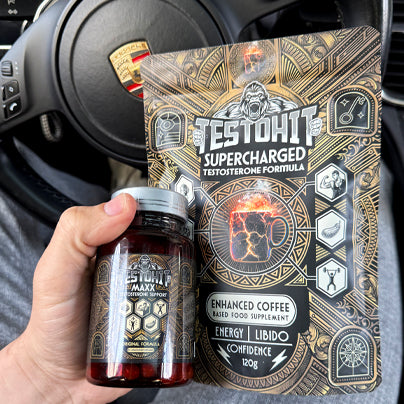
We include creatine in SUPERCHARGED because it works in tandem with direct testosterone-support ingredients like shilajit and fenugreek. While the herbs support your baseline production, the creatine ensures you can make the most of that production in the gym.
Think of your testosterone as the engine and creatine as the high-octane fuel. One supports the health of the machinery, and the other allows you to push that machinery to its limit. This combination is particularly effective for men over 30 who are starting to see a decline in both their hormonal output and their recovery capacity. You can see the full breakdown of this formula here: Try SUPERCHARGED Testosterone Coffee
Is creatine a steroid?
Creatine is not a steroid. It is a naturally occurring compound found in red meat and fish, and your body produces it in small amounts every day.
Steroids are synthetic versions of hormones that shut down your natural production. Creatine does the opposite; it supports your natural energy systems and does not interfere with your body's feedback loops for testosterone. It is one of the safest and most effective performance tools available, with decades of safety data to back it up.
Frequently Asked Questions
Does creatine increase testosterone?
No, creatine does not directly increase total testosterone. However, it can increase DHT and improve the hormonal response to heavy resistance training.
Does creatine raise DHT?
One study found that creatine loading could increase DHT levels by over 50%. While this hasn't been consistently found in every study, there is a clear mechanism for creatine to influence DHT conversion.
Should I take creatine if I want to boost testosterone?
If you are also lifting weights, yes. Creatine will help you train harder, which is the best natural way to keep your testosterone levels high as you age.
Does creatine affect testosterone levels long-term?
There is no evidence that long-term creatine use suppresses your natural testosterone production. It remains one of the safest supplements for long-term use.
Can creatine cause hair loss?
If you are genetically predisposed to male pattern baldness, the increase in DHT from creatine might accelerate the process. For men without that genetic sensitivity, it is usually not a concern.
Is creatine a steroid?
No. Creatine is a nitrogenous organic acid that helps supply energy to cells, primarily muscle cells. It has no structural or functional similarity to anabolic steroids.
TestoHit SUPERCHARGED combines creatine with direct hormonal support like shilajit and zinc. This allows you to train at a higher intensity while maintaining a healthy hormonal baseline. Get it here: Try SUPERCHARGED Testosterone Coffee


